Thursday, April 9 2026
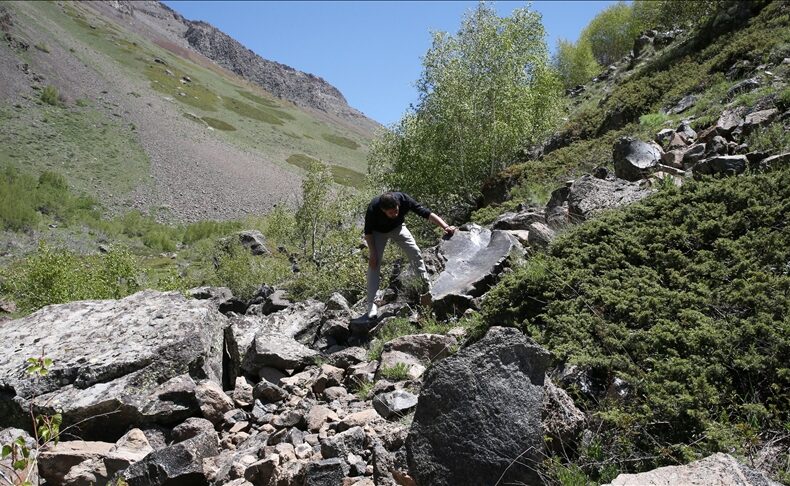
A 600-year-old Ottoman endowment inscription carved directly into natural bedrock has been restored in Amasya, northern Türkiye. Dating to 1418, the Bayezid Pasha foundation text is now readable again after years of damage, and experts say it may represent the only known example of a waqf inscription carved into living rock anywhere in the world. Located along the banks of the Yeşilırmak River, near the Leğenkaya Waterfall, the inscription had long been obscured by graffiti and surface deterioration. The recent restoration has not only cleaned the stone but also revealed a rare form of Ottoman documentation—one that was literally engraved into the landscape. A waqf text carved into living rock Commissioned by Grand Vizier Bayezid Pasha during the reign of Ottoman Sultan Mehmed I, the inscription differs fundamentally from typical waqf documents. Instead of being written on paper or carved onto a separate stone slab, the text was engraved directly into the natural rock surface. Before carving began, the rock face was carefully leveled to create a smooth plane resembling polished marble. The inscription, executed in relief, spans approximately 3 meters in width and 110 centimeters in height. It consists of eight lines in Arabic script and contains around 125 words, excluding particles. This deliberate and permanent method of inscription suggests a strong intention to embed the legal and charitable framework of the foundation into the physical environment itself. From vandalized surface to readable text Over time, the inscription suffered significant damage. Spray paint, scratches, and informal markings had turned the surface into what locals described as a “writing board,” obscuring much of the original text. The restoration process involved carefully removing paint residues using a controlled micro-abrasion technique with travertine powder. The weakened stone surface was then stabilized with compatible conservation materials. To improve legibility, conservators applied subtle shading, allowing the carved letters to stand out more clearly without altering the original structure. As a result, the inscription has regained much of its visual clarity. Protected for the future The intervention went beyond cleaning and stabilization. A reinforced protection system was installed around the site, including structural supports and a transparent protective layer over the inscription itself. Lighting was also added to enhance nighttime visibility, ensuring the inscription can be appreciated while remaining protected from further environmental and human damage. Why this inscription matters Waqf (endowment) documents played a central role in the Ottoman world, defining how religious, social, and charitable institutions were funded and maintained. These texts were typically recorded in manuscripts or occasionally inscribed on architectural elements. The Amasya example stands apart. By carving the endowment directly into bedrock, its creators transformed a legal document into a permanent public statement embedded in the natural landscape. According to regional heritage officials, this characteristic may make it the only known rock-cut waqf inscription of its kind globally—a claim that, if further supported, would place the monument in a unique position within both Ottoman studies and the broader history of epigraphy.

Anatolian News . Black Sea

600-Year-Old Rock-Cut Ottoman Endowment Inscription Restored in Amasya, Possibly Unique Worldwide

Written by

A 600-year-old Ottoman endowment inscription carved directly into natural bedrock has been restored in Amasya, northern Türkiye. Dating to 1418, the Bayezid Pasha foundation text is now readable again after years of damage, and experts say it may represent the only known example of a waqf inscription carved into living rock anywhere in the world.

3,000-Year-Old Phrygian Rock Tomb Converted Into a Café

3,000-Year-Old Phrygian Rock Tomb Converted Into a Café

In the İhsaniye district of Afyonkarahisar, Türkiye, a 3,000-year-old rock tomb belonging to the ancient Phrygian civilization has been controversially converted into a café. The site, part of the Phrygian Valley and listed as a UNESCO tentative cultural heritage, has sparked significant backlash from experts and the public alike. The Significance of the Phrygian Valley

Hagia Sophia

Hagia Sophia in Crisis: “A 1,500-Year-Old Legacy on the Brink of Collapse”

Experts Sound the Alarm: “This is no longer a mosque or museum—it’s an emergency site” Built by the order of Byzantine Emperor Justinian I in 537 AD, Hagia Sophia has stood at the heart of Istanbul for nearly 1,500 years. Originally constructed as a cathedral, later converted into a mosque, then a museum, and once

Çatalhöyük

Around 9,000 Years Ago: What Role Did Women Play in Çatalhöyük Society? New Discoveries Reveal Insights

Located in central Anatolia, the ancient settlement of Çatalhöyük continues to provide valuable insights into early human civilization. Recent interdisciplinary research has revealed that women held a significant role in shaping social structures nearly 9 millennia ago. An international team of scientists from Turkey, Denmark, Sweden, and the US examined the genetic makeup of 131

Yumuktepe Mound

New Discoveries from the Early Bronze Age Unearthed at Yumuktepe Mound in Türkiye

Archaeologists in southern Türkiye have uncovered rare Early Bronze Age remains at Yumuktepe, one of the oldest continuously inhabited settlements in the world. The findings include a horseshoe-shaped hearth, a grain silo, and traces of ancient agricultural activity. Yumuktepe Mound, located in Mersin near the Mediterranean coast of Türkiye, continues to reveal its secrets through

The Stratonikeia Library

The Stratonikeia Library, Raised by the Hands of a Master from Ephesus, Emerges from the Earth

In the Yatağan district of Muğla, Turkey, a long-silent sanctuary of knowledge nestled among timeworn marble stones is being brought back to life through the meticulous work of archaeologists. Located in the ancient city of Stratonikeia — often referred to as the “City of Gladiators” — a Roman-era library is reemerging, captivating history enthusiasts not

Tralleis Ancient City to Open to Visitors: A 23-Year Dream Comes True

Tralleis Ancient City to Open to Visitors: A 23-Year Dream Comes True

One of Turkey’s hidden archaeological gems, Tralleis Ancient City in Aydın, is set to welcome visitors starting August 2025. This milestone marks the fulfillment of a 23-year dream for excavation director Prof. Dr. Murat Çekilmez, who has dedicated his entire academic career to this historic site. From Student Volunteer to Excavation Director Prof. Çekilmez first

Ephesus Ancient City Now Open at Night

Ephesus Ancient City Now Open at Night: A Magical Journey Through Time Under the Stars

Ephesus, one of Turkey’s most iconic UNESCO World Heritage Sites, is now offering visitors a unique opportunity to explore its ancient streets under the night sky. As part of a new initiative by the Turkish Ministry of Culture and Tourism, the historical site is illuminated with special lighting, creating a mesmerizing atmosphere after sunset. Walk

2,400-Year-Old Shops to Be Unearthed in Hyllarima, One of Anatolia’s Best-Preserved Ancient Cities

2,400-Year-Old Shops to Be Unearthed in Hyllarima, One of Anatolia’s Best-Preserved Ancient Cities

Ongoing archaeological excavations in Hyllarima Ancient City, located in the Kavaklıdere district of Muğla, southwestern Türkiye, continue to shed light on the region’s rich past. Known as one of the rare ancient settlements in Anatolia that has remained remarkably well-preserved, Hyllarima is now revealing new secrets—2,400-year-old shop structures located in the heart of the ancient

Kedrai Ancient City

Excavations Begin at Kedrai Ancient City: Sedir Island’s Hidden History Resurfaces

The 2025 archaeological excavation season at Kedrai Ancient City, located on Sedir Island in Muğla’s Marmaris district, will officially begin on June 23. This year’s work will focus on deepening research around the grand basilica and ancient theater. Sedir Island’s historical treasure Kedrai prepares for a new excavation season Situated off the coast of Muğla’s

19,000-Year-Old Stone Figurines Unearthed in Türkiye’s Kızılin Cave

19,000-Year-Old Stone Figurines Unearthed in Türkiye’s Kızılin Cave Rewrite Prehistoric Art History

A groundbreaking archaeological discovery in southern Türkiye is reshaping our understanding of symbolic behavior and artistic expression in prehistoric Anatolia. Excavations at Kızılin Cave, located near Yağca in Antalya’s Döşemealtı district, have uncovered stone human figurines dating back nearly 19,000 years — the oldest known of their kind in the region. As reported by Koray

1 35 36 37 38 39 118