Sunday, December 7 2025
12 Ancient Human Skulls Unearthed at Sefertepe

Anatolian News . Southeastern Anatolia

A Newly Identified Boar Piglet Engraving Emerges from Sefertepe’s 2025 Excavations

Written by

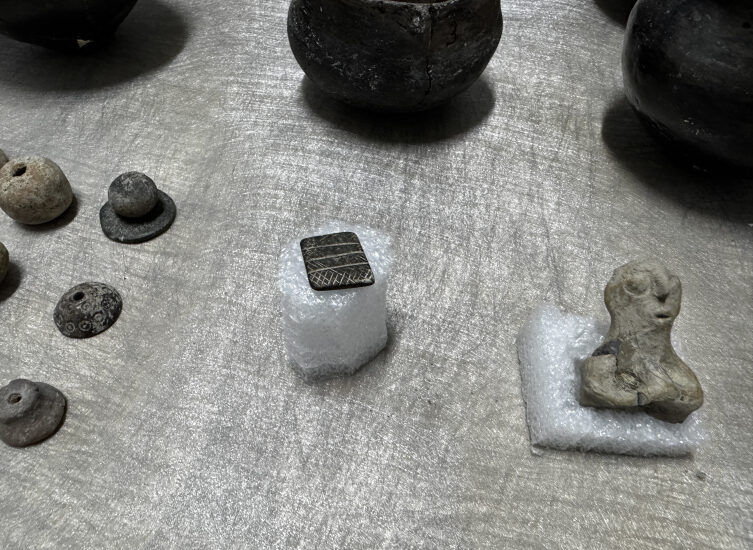
The 2025 excavation season at Sefertepe, a rapidly emerging Neolithic site within the broader Taş Tepeler landscape of southeastern Türkiye, has brought to light a striking example of early symbolic expression. During ongoing fieldwork directed by Assoc. Prof. Dr. Emre Güldoğan of Istanbul University’s Department of Prehistoric Archaeology, researchers identified a finely incised depiction of

Gökhöyük

Unbroken Life Through the Ages: 8,000 Years of Continuous Settlement Unearthed at Gökhöyük in Konya

Archaeologists in Türkiye’s central province of Konya have uncovered evidence of an extraordinary 8,000-year span of continuous human habitation at Gökhöyük (also known as Kanal Höyük), located in the Seydişehir district. First identified by British archaeologist James Mellaart in 1954, the site reveals settlement layers dating from the 7th millennium BCE to the 1st millennium

Archaeologists have uncovered a T-shaped pillar carved with a human face at the Neolithic site of Karahantepe in southeastern Türkiye — a discovery described as a first in human history. The finding was announced by Minister of Culture and Tourism Mehmet Nuri Ersoy on his official X (Twitter) account, where he wrote: “Karahantepe — A first in history! Within the scope of our Taş Tepeler Project, a T-shaped pillar with a human face has been unearthed for the first time.” The discovery forms part of the Taş Tepeler (Stone Hills) Project, a long-term archaeological initiative led by the Turkish Ministry of Culture and Tourism, which explores the earliest stages of human settlement and symbolic expression in the Şanlıurfa region. A Turning Point in Neolithic Symbolism For decades, the T-shaped pillars of Göbeklitepe and Karahantepe have been interpreted as stylized human figures, primarily due to the carved arms and hands visible on many examples. Yet, this new pillar — the first to bear a carved human face — marks a major leap in understanding how early Neolithic societies perceived themselves. The pillar’s face, featuring deep-set eyes, a pronounced nose, and sharp contours, resembles other human sculptures from Karahantepe. Experts say the find reflects not only the craftsmanship of early Anatolian communities but also their emerging capacity for abstract and self-referential thought. From Symbol to Identity Until now, these T-shaped monoliths were thought to serve either as structural elements or abstract human representations. The new find, however, provides the first direct depiction of the human visage, offering a rare glimpse into the earliest stages of self-image in human history. Karahantepe and the Taş Tepeler Network Dating back approximately 12,000 years, Karahantepe is one of several interconnected sites in the Taş Tepeler region, which also includes Göbeklitepe, Sefertepe, Sayburç, Harbetsuvan Tepesi, and Çakmaktepe. These settlements continue to reshape our understanding of humanity’s transition from nomadic life to organized, temple-centered communities. Together, they position Anatolia as one of the earliest centers of symbolic architecture and spiritual innovation.

A Historic First at Karahantepe: Human-Faced T-Shaped Pillar Unearthed in Türkiye

Archaeologists have uncovered a T-shaped pillar carved with a human face at the Neolithic site of Karahantepe in southeastern Türkiye — a discovery described as a first in human history. The finding was announced by Minister of Culture and Tourism Mehmet Nuri Ersoy on his official X (Twitter) account, where he wrote: “Karahantepe — A

Garibin Tepe

Ongoing Excavations at Garibin Tepe Near Van Shed Light on Urartian Architecture and Conservation Efforts

Archaeological works continue at Garibin Tepe in Türkiye’s Van province, one of the most intriguing Urartian sites of recent years. Excavations this season have focused on documenting massive walls, lion statues, and wall paintings as researchers seek to understand the architectural layout and royal character of the ancient complex. Located about 30 kilometers from central

Rare Egyptian Relief Depicting God Tutu Found in Roman Bath at Sagalassos: Crafted from Afyon Marble

Rare Egyptian Relief Depicting God Tutu Found in Roman Bath at Sagalassos: Crafted from Afyon Marble

Archaeologists at the ancient city of Sagalassos in Türkiye’s Burdur province have identified a rare marble relief depicting the Egyptian sphinx-god Tutu, carved from Afyon (Docimian) marble and discovered inside a Roman bath complex. The finding — a striking blend of Anatolian craftsmanship and Egyptian iconography — reveals how distant cultures interacted in the artistic

Scientists Identify the Woman Behind a 2,000-Year-Old Marble Head Found in Crimea

Scientists Identify the Woman Behind a 2,000-Year-Old Marble Head Found in Crimea

Researchers from Poland and Spain reveal that the ancient sculpture depicts a Roman lady named Laodike A team of researchers from Poland and Spain has identified the subject of a marble female head discovered in Crimea in 2003 as Laodike, a Roman woman who lived in the early centuries CE.According to the study, Laodike was

Unique in the World: The Eros Mosaic from Yumurtalık Shows the God of Love Fishing on a Hippocampus

Unique in the World: The Eros Mosaic from Yumurtalık Shows the God of Love Fishing on a Hippocampus

Discovered during rescue excavations in 2013 in the coastal town of Yumurtalık (ancient Aegeai) in southern Türkiye, the mosaic depicts the love god Eros fishing while riding a Hippocampus—a half-horse, half-fish sea creature. Scholars describe it as a one-of-a-kind example in the entire Mediterranean world. From rescue excavation to museum The mosaic was unearthed in

3,200-Year-Old Hittite Sculpture Workshop in Yozgat Damaged by Looters

3,200-Year-Old Hittite Sculpture Workshop in Yozgat Damaged by Looters

A 3,200-year-old Hittite sculpture workshop in Karakız, a village in Sorgun district of Yozgat, Türkiye, is being ravaged by illegal excavations. A basalt lion statue—one of the few surviving examples of Hittite stonework in the region—has been severely damaged by treasure hunters, raising urgent calls for protection. Archaeologists have identified the site as a rare

2,800-Year-Old Sanctuary of the Phrygian Mother Goddess Matar Unearthed at Attouda Ancient City

2,800-Year-Old Sanctuary of the Phrygian Mother Goddess Matar Unearthed at Attouda Ancient City

Archaeologists working at the ancient city of Attouda in Denizli’s Sarayköy district have uncovered a sanctuary dedicated to the Phrygian Mother Goddess Matar (Kybele), dating back 2,600–2,800 years. The discovery includes a monumental rock sanctuary, a sacred cave, and a unique twin rock idol. The excavations are carried out under the supervision of Hulusi Ünsal,

Dollar of the Middle Ages

The ‘Dollar of the Middle Ages’ Found in Smolensk: 48 Silver Coins Reveal Trade Links from Lithuania to Crimea

Archaeologists in Smolensk have unearthed a 600-year-old treasure of 48 silver coins, including Prague groschen—known as the “Dollar of the Middle Ages”—a Lithuanian denarius from the reign of Vytautas the Great, and a rare Crimean dang. The find highlights Smolensk’s role as a crossroads of trade and political struggle in early 15th-century Eastern Europe. The

1,800-Year-Old Roman Agora Unearthed in the Ancient City of Metropolis

1,800-Year-Old Roman Agora Unearthed in the Ancient City of Metropolis

Archaeologists excavating the ancient city of Metropolis in İzmir, Türkiye, have uncovered a 1,800-year-old Roman-era agora that once served as the commercial heart of the settlement. Experts suggest it may be the largest trade center ever identified in the city. Located between the modern villages of Yeniköy and Özbey in Torbalı, Metropolis is also known

1 7 8 9 10 11 107